Machining Processes
3-Axis vs. 5-Axis CNC Milling: Choosing the Right Process
How part geometry, setup count, tolerance stack-up, and production volume decide whether a job belongs on a 3-axis or a 5-axis machine.
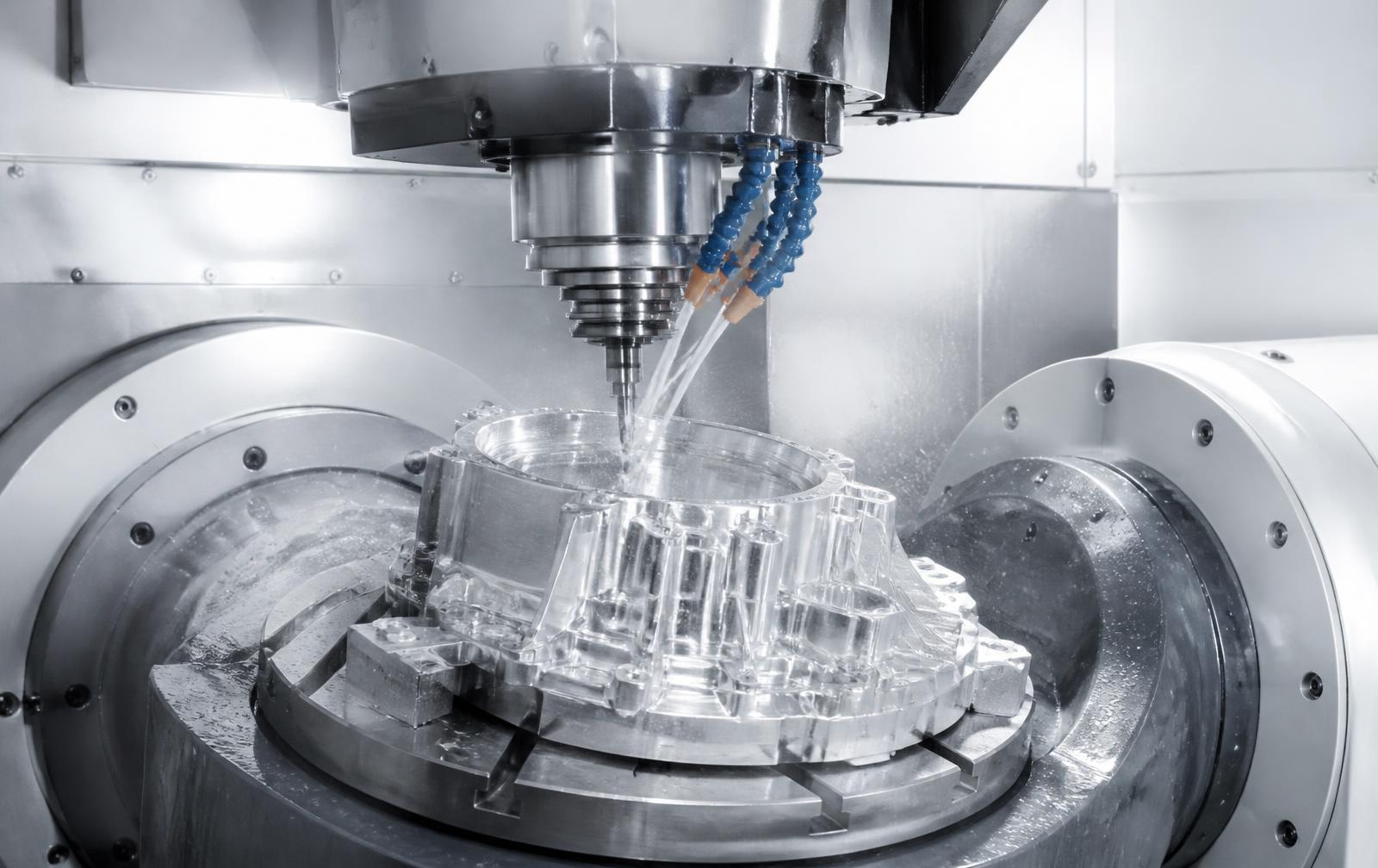
The choice between 3-axis and 5-axis milling is usually framed as a machine question. In practice it is a setup question. A 3-axis machine moves the cutter in X, Y, and Z while the part stays fixed in one orientation. A 5-axis machine adds two rotary axes, so the cutter can reach features on multiple faces — and approach them at an angle — without the part being unclamped and re-fixtured.
That single difference drives most of what follows: how many setups the job needs, how tolerances stack between features on different faces, what surface finish is achievable on contoured geometry, and where the cost sits between programming, fixturing, and cycle time.
Start with the geometry
Geometry is the first filter. Ask what the part actually requires the cutter to reach.
- Prismatic parts — plates, brackets, manifolds, and housings whose features are perpendicular to a small number of flat datum faces. These are natural 3-axis work.
- Angled and compound features — bosses, ports, or bolt circles that sit on a face that is not square to the machine table. On a 3-axis machine these need either a tilted fixture or a separate setup.
- Continuous contour — impeller-style blades, organic transitions, and blended fillets where the tool axis must change as the cutter travels. This is where simultaneous 5-axis motion is not a convenience but a requirement.
- Deep or shadowed features — pockets and undercuts where a short, rigid tool can only reach if it is tipped. Tipping the tool lets you use a shorter cutter, which reduces deflection and chatter.
A useful test: sketch how many distinct directions the cutter has to come from. One or two directions is a 3-axis conversation. Four or more, or any direction that is not orthogonal, points toward 5-axis machining.
Setups, and why they matter more than cycle time
Every time a part is removed and re-clamped, three things happen: the operator spends time, a new fixture or set of soft jaws may be needed, and the part is re-located against a datum. Re-location is the part that engineers underestimate. Positional error between features machined in different setups is limited by how repeatably the part can be picked up again, not by the accuracy of the machine's servos.
Consolidating operations into fewer setups therefore does two things at once: it removes handling labor, and it removes a source of feature-to-feature variation. When a drawing calls out tight positional or perpendicularity relationships between features on opposing faces, machining those features in one setup is usually the cleanest path to holding them.
Where 3-axis stays the better answer
None of this makes 3-axis obsolete. If the part is prismatic and the critical relationships live on one face, a 3-axis setup is faster to program, faster to prove out, and easier to fixture repeatably in a vise. Programming time and first-article effort are real costs, and a simpler process carries less of both.
Comparing the two processes
| Consideration | 3-Axis Milling | 5-Axis Milling |
|---|---|---|
| Best-fit geometry | Prismatic parts, features square to one or two datum faces | Multi-face, angled, and contoured geometry |
| Typical setups | More setups as face count increases | Fewer setups; often one or two |
| Feature-to-feature relationships | Limited by fixture repeatability between setups | Held within a single setup where possible |
| Tooling reach | Longer tools needed for deep or shadowed features | Shorter, more rigid tools by tipping the tool axis |
| Programming and proveout | Simpler, faster to verify | More CAM effort; collision checking required |
| Fixturing | Vises and simple plates; more fixtures across setups | Fewer fixtures, but often purpose-built for access |
| Where cost concentrates | Handling labor across repeated setups | Programming, fixture design, and machine time |
Production volume changes the math
Volume decides how the fixed costs of a process get amortized.
- Prototypes and one-offs. Programming and fixturing are a large share of the total. Reducing setups on a 5-axis machine can win outright, because there is no production run over which to spread multi-setup handling.
- Low-to-mid volume. This is where the decision is genuinely open. Compare the total of programming plus fixturing plus per-piece handling for each approach, rather than comparing spindle time alone.
- Repeat production. Fixed costs are spread thin, so per-piece time and process stability dominate. A well-fixtured 3-axis process with quick-change workholding can be extremely competitive; a 5-axis process still wins when it eliminates a setup from every piece.
For ongoing releases, tell your supplier the expected annual quantity and release pattern. The same part quoted as a batch of 10 and as a recurring 500-per-year program can reasonably be routed to different processes.
Cost drivers worth reviewing before you quote
- Setup count. Often the largest single lever on low-volume work.
- Tool length and access. Deep features machined with long tools require lighter cuts and more passes.
- Fixture complexity. Holding a part so five faces stay accessible sometimes needs a dedicated fixture.
- Material behavior. Removal rates, tool wear, and work-hardening differ by alloy and affect both approaches, though not equally.
- Tolerance scheme. Which features are actually critical, and whether those relationships cross faces. See tolerance standards for how we treat general versus critical callouts.
A short decision path
- Identify the datum scheme and count the directions the cutter must approach from.
- Flag every tolerance that relates features on different faces.
- Estimate setups for each approach, including any tilted or purpose-built fixtures.
- Weigh programming and fixture cost against per-piece handling at your real volume.
- Confirm inspection method early, so the process and the measurement plan agree.
Most parts sort themselves out quickly with this sequence. The ones that do not are usually worth a conversation before the drawing is released — a small change to a datum or a relaxed non-critical callout can move a part from a four-setup job to a two-setup job.
Details of both platforms are on our CNC milling and 5-axis machining pages.